


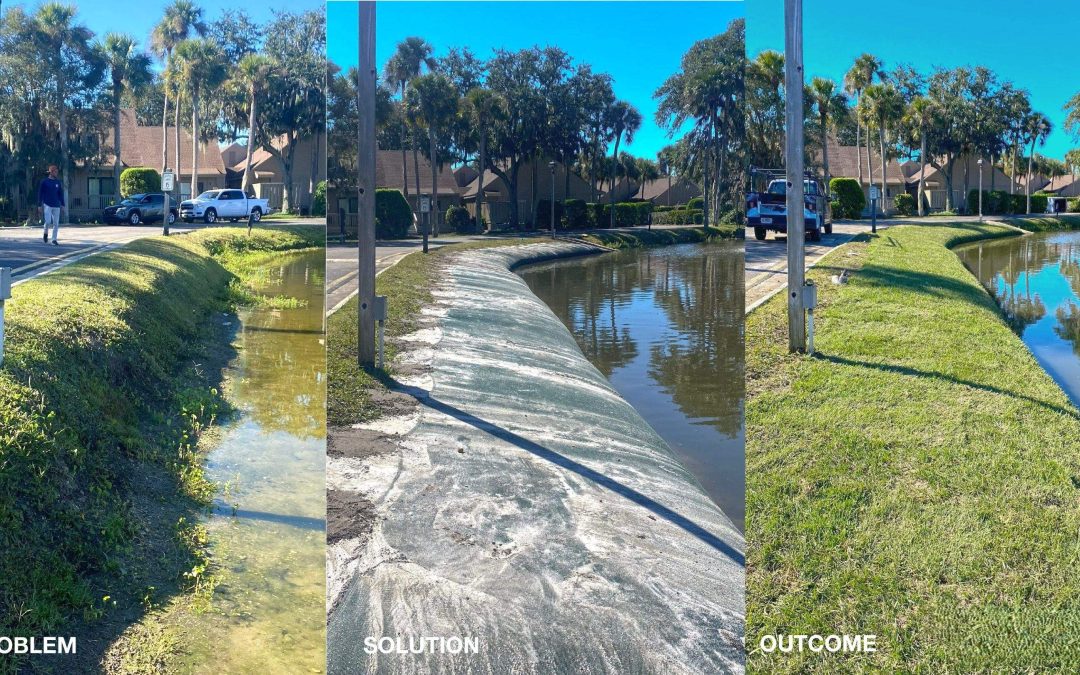
Undercut banks, collapsing turf, and widening pond edges are signs that shoreline erosion is already progressing. Professional shoreline erosion repair in Houston restores the bank, reduces future soil loss, and protects the surrounding stormwater infrastructure. This guide explains how erosion develops, which stabilization methods work, and when corrective action is necessary for Houston-area ponds.
How is pond shoreline erosion repaired? Shoreline erosion repair restores damaged pond banks by rebuilding the slope, correcting drainage problems, and installing stabilization materials such as vegetation, reinforced matting, riprap, concrete products, or sheet piling. The appropriate solution depends on erosion severity, bank angle, soil conditions, wave action, site access, and the pond’s stormwater function.
Shoreline Erosion Progresses From Undercutting to Bank Failure
Shoreline erosion begins when moving water removes soil from the base of a pond bank. Once a cavity forms beneath the shoreline, the upper soil loses support. Grass-covered sections then crack, slump, and eventually fall into the water.
Common causes include:
- Wind-driven waves and fluctuating water levels
- Fountain, aerator, or pump discharge directed toward the bank
- Concentrated stormwater runoff
- Pedestrian and maintenance-equipment traffic
- Burrowing animals
- Sparse or damaged shoreline vegetation
- Banks constructed at angles too steep for the soil
- Failed pipes, outfalls, or drainage channels
Erosion generally advances through recognizable stages:
- Minimal erosion: a small cavity appears near the waterline.
- Moderate erosion: the turf remains visible, but the soil beneath it has been removed.
- Severe erosion: the bank cracks, slumps, and complete sections of shoreline break into the pond.
A newly built bank starts smooth, then becomes undercut, leaves turf unsupported, fails along the slope, and eventually collapses. Unprotected shoreline can deteriorate quickly once stabilizing vegetation is lost.
Houston-area properties face additional pressure from frequent rainfall, rapid water-level changes, Gulf Coast storm patterns, and expansive clay soils. Heavy clay can look stable when dry, then soften, shrink, crack, and lose strength as moisture conditions change. Repeated wetting and drying accelerates bank movement, particularly where runoff enters the pond at concentrated locations.
Eroded soil also settles into the pond. This sediment reduces depth, creates shallow shelves, and provides growing conditions for nuisance aquatic vegetation and algae. A shoreline problem can therefore turn into a water-quality and sediment removal problem. A professional pond and stormwater assessment in Houston can find the cause before the damage spreads.
LMS Matches the Stabilization Method to the Site
Effective shoreline stabilization addresses both the failed bank and the force causing the failure. Covering an eroded edge without correcting concentrated runoff, steep grading, wave energy, or drainage defects usually produces only a temporary result.
An LMS shoreline evaluation typically examines:
- The length and severity of the damaged bank
- The slope between the top of bank and the normal water level
- Soil type and moisture conditions
- Water-level fluctuations and wave exposure
- Nearby inlets, outlets, pipes, and drainage channels
- Fountain or aeration equipment
- Trees, utilities, fences, buildings, and access limitations
- The pond’s approved drainage or stormwater design
- Safety, appearance, maintenance, and budget requirements
The repair process begins by removing unstable material and rebuilding the bank to a workable grade where site conditions allow. Compacted soil or engineered fill is placed to restore the shoreline profile. Drainage problems are corrected so runoff does not keep cutting across or beneath the repaired area. LMS then selects a stabilization system based on bank geometry and expected hydraulic stress. You can also learn about LMS’s ShoreSOX erosion solutions.
Vegetation and reinforced planting systems
A gradual bank with limited wave energy can often be stabilized with turf, native grasses, noninvasive marginal plants, erosion-control blankets, or reinforced vegetative mats. Plant roots bind the soil, while stems and leaves reduce the force of water reaching the bank.
Marginal aquatic vegetation also provides habitat and absorbs nutrients from the water. Plantings must be selected and managed carefully, however, because aggressive species can obstruct drainage structures or spread beyond the intended area. Aquatic vegetation management helps keep plantings in check.
Riprap and aggregate stabilization
Riprap consists of appropriately sized stone placed over filter fabric or a prepared aggregate base. The stone absorbs and disperses wave energy, while the underlying layer helps keep soil from washing through the gaps.
Riprap is useful along exposed pond edges, outfall areas, and banks that need durable protection without a vertical retaining structure. Proper sizing, toe installation, and fabric placement are essential. A thin layer of loose stone placed directly over unstable soil does not perform the same as a designed installation.
Hard-edge stabilization
Steep banks, restricted shorelines, and areas exposed to persistent water movement often require a harder edge. Options include concrete slope paving, articulated concrete block, trenched concrete, segmental block systems, timber structures, and vinyl or steel sheet piling.
Sheet piling provides a defined vertical edge and can preserve usable land where regrading the bank is not practical. The final selection depends on soil conditions, expected loads, water depth, design life, access, appearance, and whether existing structures must be removed.
A qualified contractor should explain why a particular system fits the property rather than applying one material to every shoreline. Shoreline erosion repair projects in Houston frequently combine methods, such as grading and vegetation along sheltered banks with riprap or sheet piling at high-energy locations.
Delaying Repair Increases Property Damage and Project Scope
Active shoreline erosion does not stop after the first section collapses. Newly exposed soil remains vulnerable to wave action and rainfall, allowing the failure to move farther into the property.
Consequences of postponing repair include:
- Loss of landscaped common area
- Damage to walking paths, fences, irrigation, lighting, and utilities
- Exposure or displacement of stormwater pipes and outfalls
- Increased sediment accumulation within the pond
- Reduced pond depth and stormwater-storage capacity
- Expansion of shallow areas that support weeds and algae
- Unsafe drop-offs near recreational or maintenance areas
- Higher repair costs as access and bank conditions deteriorate
For an HOA board or community manager, continued land loss can also lead to resident complaints and questions about common-area maintenance. Facility managers and commercial property managers face similar concerns when erosion approaches parking areas, access roads, buildings, or buried infrastructure.
Early intervention usually preserves more stabilization options. A small undercut area can sometimes be corrected with localized grading and vegetative reinforcement. A bank that has retreated several feet often requires imported fill, heavier equipment, structural materials, sediment removal, and professional design.
Shoreline Work Must Support Texas Stormwater Compliance
Pond-bank repairs must preserve the drainage facility’s approved function and avoid creating new stormwater problems. Shoreline stabilization is not automatically a regulatory violation, but work involving significant grading, sediment disturbance, drainage structures, or regulated waterways can require permits, notifications, engineered plans, or erosion controls.
The Texas Commission on Environmental Quality (TCEQ) regulates stormwater discharges from construction sites, industrial facilities, and publicly operated storm-sewer systems. Construction activities that disturb one acre or more generally fall under the state’s Construction General Permit requirements, including stormwater pollution-prevention measures and coordination with the receiving MS4 when applicable.
Texas Municipal Separate Storm Sewer System (MS4) permit holders must implement stormwater management programs intended to reduce pollutants entering storm drains, creeks, lakes, and other surface waters. Local governments can also set development, inspection, and maintenance requirements for privately owned stormwater BMPs.
In Harris County, the Office of the County Engineer’s Watershed Protection division reviews stormwater-quality plans and inspects regulated construction and post-construction stormwater facilities. Qualifying stormwater-quality permits may also need to be renewed annually after a facility receives its Certificate of Compliance.
Before beginning a corrective repair, the property owner or responsible association should confirm:
- Who owns and maintains the pond or BMP
- Whether the pond is covered by recorded maintenance documents
- Whether an easement limits grading or construction
- Whether local plan approval or engineering documentation is required
- Whether construction-stormwater permit coverage applies
- How disturbed soil and sediment will be contained
- Whether the finished repair changes storage volume, flow paths, or outlet elevations
Regular inspections through a scheduled pond and lake maintenance program help catch shoreline problems early. For related guidance, see our post on retention pond maintenance in Houston.
Why Houston Shorelines Need Early Repair
The right stabilization approach depends on local soil, rainfall, geology, and regulatory conditions.
Houston and Gulf Coast communities
In Houston and surrounding Gulf Coast communities, heavy rainfall and rapid pond-level changes repeatedly saturate and expose shoreline soils. Clay-rich banks, intense runoff, and storm-driven wave action make drainage correction and toe protection especially important.
Dallas–Fort Worth
Properties in Dallas–Fort Worth commonly experience alternating drought and heavy rainfall. Dry periods can crack and weaken exposed soil, while intense storms wash loosened material into the pond. Stabilization must account for both runoff velocity and seasonal soil movement.
San Marcos and the Austin metro
San Marcos and the Austin metro include limestone terrain, shallow soils, sensitive waterways, and aquifer-related considerations. Projects that affect drainage systems or environmentally sensitive areas require early coordination with the appropriate jurisdiction.
Is your Houston pond bank eroding? Contact LMS or call (281) 240-6444 to schedule a stormwater compliance evaluation or corrective repair assessment for your property. LMS evaluates shoreline conditions, drainage influences, stabilization options, access requirements, and applicable stormwater obligations across Houston, Dallas–Fort Worth, San Marcos, and the Austin metro.
Shoreline Erosion Repair in Houston: Frequently Asked Questions
What causes pond bank erosion in Houston?
Common causes include wind-driven waves, fluctuating water levels, concentrated stormwater runoff, steep banks, sparse vegetation, and failed pipes or outfalls. Houston’s heavy rainfall and expansive clay soils can speed up the damage, especially where runoff enters the pond at one point.
How do I know whether a pond shoreline needs repair?
Visible undercutting, cracked turf, leaning fences, exposed roots, collapsed soil, and a widening waterline indicate active erosion. Sediment deltas, shallow shelves, and repeated muddy water near the bank also show that soil is entering the pond.
What is the most effective material for shoreline erosion control?
No single material is appropriate for every site. Vegetation and reinforced mats work well on gradual, lower-energy banks, while riprap, concrete systems, or sheet piling are more appropriate for steep banks, limited space, or sustained wave exposure.
How much does shoreline erosion repair cost?
Cost depends on repair length, bank height, erosion severity, stabilization material, equipment access, soil requirements, water depth, and nearby structures. Repairing a small undercut area generally requires fewer materials and less site work than rebuilding a collapsed shoreline. A site assessment is needed for a reliable estimate.
Can shoreline erosion affect a stormwater inspection?
Yes. Erosion can expose pipes, obstruct inlets or outlets, add sediment to a BMP, alter slopes, and reduce the facility’s intended performance. A community manager or property manager should document the condition and determine whether the responsible MS4, county, municipality, or engineer requires corrective action.
Does shoreline erosion repair in Houston require a permit?
Permit requirements depend on the amount of disturbed soil, the property’s jurisdiction, the pond’s approved plans, and whether the work affects regulated drainage infrastructure or waterways. The owner should verify TCEQ construction-stormwater requirements, local MS4 rules, easements, and municipal or county approvals before work begins.


